The Global Wealth Management Forum • 2026 Shanghai Suhewan Conference was held in Shanghai on October 16 and 17. Tim Cook, Executive Chairman of Apple and Chairman of the Advisory Board of Tsinghua University School of Economics and Management, and Bai Chong-en, Chairman of the Executive Committee of the Global Wealth Management Forum, Dean of Tsinghua University School of Economics and Management, and Executive Dean of the Institute for Global Development of Tsinghua University, engaged in a dialogue on the theme "Facing the New World in the Context of Human + AI ."
This was Tim Cook's second time attending the summit, following the 2025 Shanghai Suhewan Conference. Tim Cook and Bai Chong-en exchanged in-depth views on topics including the optimism and concerns brought by AI, how AI can serve humanity, the democratization of app development, the intelligent transformation of supply chains, and the broader social role of technology companies.
Cook said he has been traveling to China for almost 30 years, and what struck him most during this trip was China's current dynamism and vibrancy, with the level of optimism about the future at an all-time high. He believes that technology should serve humanity, not the other way around; AI applications in the health sector are accelerating, and body sensors have enormous potential in providing early warning signs. He also noted that AI is driving the democratization of app development, and that supply chain automation is now far beyond what it once was—all of which requires people to be prepared for it.
Bai Chong-en, speaking from the front lines of education, pointed out that AI brings profound challenges to education: the lower rungs of the career ladder are vanishing or diminishing, and the gap between motivated and less motivated students is being further widened. To this end, Tsinghua SEM has proposed the STAR framework, identifying finding the right questions, tech-savvy, assessment, and resilience as four key capability areas. He noted that in an era when answers are readily available, asking the right questions has become even more important.
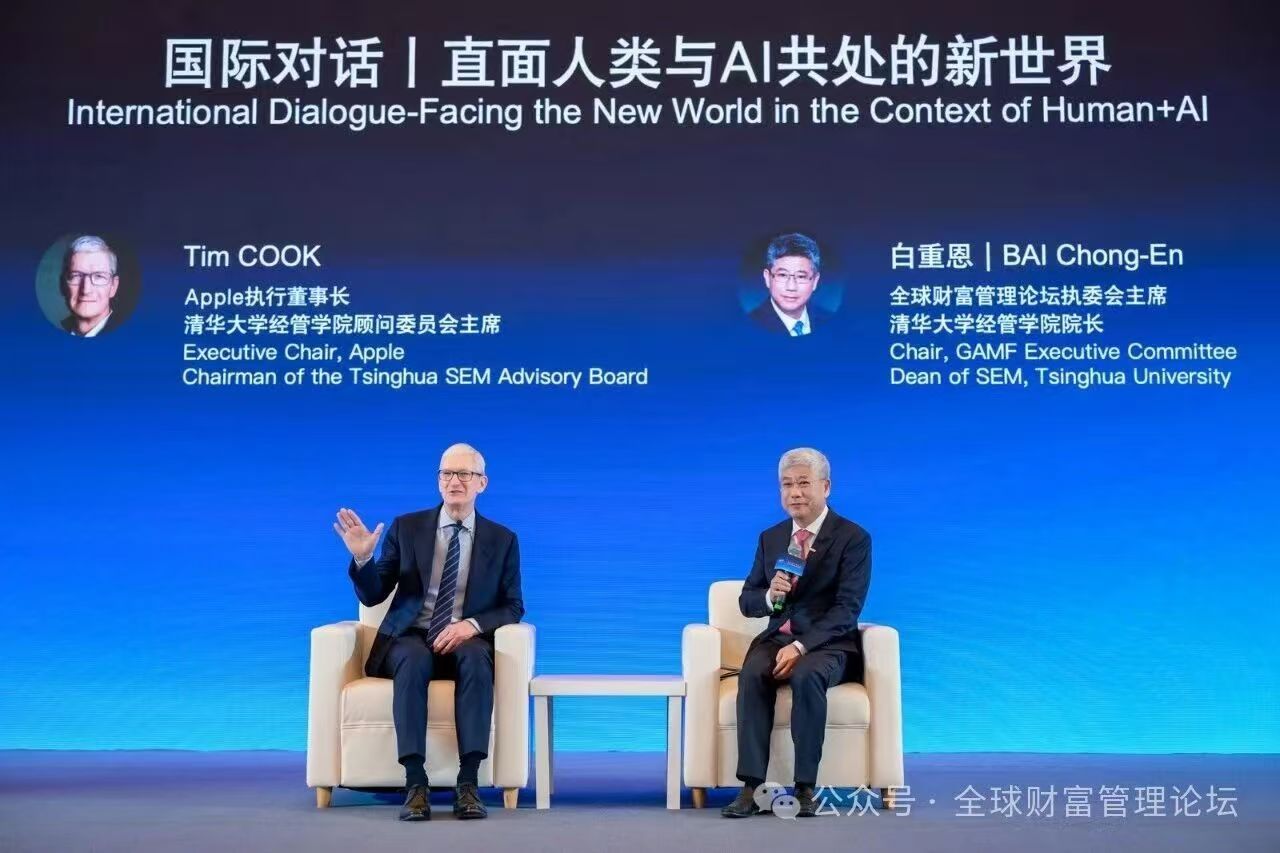
Bai Chong-en: Welcome back, Tim.
Tim Cook: It is great to be here, and I see some iPhones out there, so thank you very much.
Bai Chong-en This is the second consecutive year you are attending this conference. Thanks very much to your support for this organization.
Tim Cook: I am thrilled to be invited and back here with you, Dean Bai.
Bai Chong-en: You have been in China for a few days. You visited Guangdong and Beijing. What's your impression of your trip so far? What are the biggest takeaways from this trip?
Tim Cook: It's a good question. You know, I've been traveling to China for almost 30 years. I came for the first time in 1997, and across that period of time, I fell in love with the Chinese people and the Chinese culture. Every time I come, I’ve learnt something. This time, I started my trip in Guangdong, that is where Apple's journey started in China. Apple’s journey started with a singular part that was so hard to produce. We went to Guangdong Province for help in 1998, and that would start a huge manufacturing business that would later become a significant part of our supply chain, producing iPhones, iPads, and Macs. But what I learned was how dynamic and vibrant China is right now. From my point of view, the level of optimism about the future is at an all-time high. You see this in the way people are leaning into AI—and I don't mean just computer scientists; I mean everyone. So, I'm very much struck by the optimism. I could see it in app developers. We launched an app incubator in Beijing that had a contest this past week to see which app was the best of the best, and there were some great ones in there. What struck me was that everyone's using AI. 95% of the apps in the incubator were using AI. Again, the level of optimism and the belief that tomorrow is better than today was just paramount. I saw that at Tsinghua as well from visiting the school—the students there and how they're embracing the new world and leaning into this transformative technology. I can feel it in Shanghai as well, from our store visits and the Vibe Coder I visited yesterday. It's everywhere.
Bai Chong-en: Yes, people have different emotions toward AI. Some are more optimistic, as you suggested, while others have concerns. I'm glad you find that in China, people are more optimistic.
Tim Cook: Yes. They are definitely more optimistic. There are concerns in the world. And rightfully so. There are some concerns out there, but I think people see it more glass half full in China.
Bai Chong-en: Great, great. And the theme of today's forum is our world in the context of AI plus human. Throughout your career, you have always talked about the importance of infusing technology with humanity. At this moment of transformation around the world, how does your approach to AI reflect that philosophy?
Tim Cook: It reflects it very much, and I'm so happy about the title of this forum. Because I've always felt that technology should serve humanity, not the other way around. Technology should be all about improving people's lives. Making people live a healthier day, maybe helping people create things they couldn't create otherwise, helping people have a more productive day. Everything should be in the service of humanity. That's the way I've always seen it. Now, Dean Bai, you are presiding over a huge transformation right now at Tsinghua with students and learning, and teachers and teaching. How do you see this moment?
Bai Chong-en: A lot of people are embracing AI, but we also encounter a lot of challenges. In the classroom, one indicator that's very important to us is now how many of the students are raising their heads in the classroom. Many of them bury their attention in their computers; they don't listen to the instructor. So that's our challenge now. I think AI brings a very profound challenge to education. One is that on the career ladder, the lower rungs are vanishing or diminishing. So, you have to learn to be able to climb from the upper rung immediately. That's a grand challenge to us. Also, I think AI makes the difference between motivated students and less motivated students even wider. The problem is that with less motivated students, they can quickly find answers from AI. So, they stop learning. That's a great challenge. How do we motivate students to utilize AI to better learn instead of utilizing AI just to find a solution without the learning process. So, that's a great challenge to us. Because of these challenges, we're thinking really hard about what to teach and how to teach. In our board meeting, we presented our STAR framework—4 key areas of skills. First, S stands for Search: identifying the questions to answer. That's crucial in this new AI era. Second, T is for Tech-savvy: using traditional skills, leadership skills, etc., together with tech. Third, A is for Assessment—the ability to make judgment. Finally, R is for Resilience. With AI bringing so much uncertainty, people have to have the ability to take failure, and to face failure. So, resilience, lifetime learning, and leadership are all very important. This shapes our thinking on what and how to teach, and what and how to research. There are many issues that facing us, but I'm glad our board members gave us a lot of very valuable advices and suggestions. We'll look at their suggestions and try to improve our work even better.
Tim Cook: I think we're moving into an environment where the questions are more important than the answer. You know, education used to be: the instructor asks a question and the student's responsibility was to give an answer. Now the question becomes more important than the answer. Because in a world where the answers are known, the questions that you ask become extremely important. And I think it's a rewiring of the brain a bit.
Bai Chong-en: You mentioned how to serve humanity. How to serve? There are a lot of questions. From which angle, what approach to take to better serve humanity? So those are very important issues. We want our students to learn that quicker in their studies. And when you talked about how to make AI serving people better, you talked about making people healthier, you talk about making people more productive, etc. In the health sector, and you had a lot of optimism about how AI may impact human health. Now, last year you already talked about this. One year later, are you still as excited about this potential? And what tangible progress have you seen when it comes to AI improving people's health?
Tim Cook: I am more optimistic today than I was even last year, to be frank with you. This week has been a great week from a health point of view. We were able to launch our sleep apnea notification on the Apple Watch this week in China. As you know, sleep apnea is where the person stops breathing during the night, and this can create problems like hypertension, diabetes, and terrible outcomes. Most people that have sleep apnea don't know it. Now, the watch will notify you if you have it, so you can seek help from a medical professional to get on a CPAP machine or whatever the treatment may be. That's one example. Another example: I was in Beijing earlier this week and visited a young man who was having an irregular heartbeat. He began to get notifications very frequently on the app, which convinced him to reach out for medical help, and he was diagnosed with AFib. As you know, AFib can be a silent killer, so it's huge to notify people that they have these kinds of issues before they become very problematic. I see more and more of these things coming out and more and more these things being possible. We're now doing research with Beijing Anzhen Hospital, searching for even more early indicators on the cardiovascular side. But the bottom line is, I see enormous potential in body sensors giving early warning signs so you can live a healthier life. I also see these helpful reminders about how you're sleeping, how much exercise you're getting, and how much you're standing. All of these are very nice reminders that we all need to be more active and get a better night's rest. And getting a score the next morning that is actionable is big. You know, we can all learn from those.
Bai Chong-en: Right, last year you talked about the application of AI to alert people of falling.
Tim Cook: Yeah, that's right.
Bai Chong-en: And after they fall, they can immediately notify health service providers. So, now you're extending the service to deal with apnea.
Tim Cook: That's right.
Bai Chong-en: And to deal with difficult heart conditions. So, you're extending your service to help people deal with health risks. That's great.
Tim Cook: Think about all the ways notifications work now—from sleep-to-sleep apnea, to irregular heartbeat, to AFib. You can run an ECG on your wrist. You get a readiness score in the morning to denote your readiness for the day. You have all your exercise info. This is just your SpO2. It's an enormous amount of data, all in the service of humanity.
Bai Chong-en: Right, right. Apple has a large community of app developers in China helping people to use the phones better. And some people suggest that with AI, apps are becoming less important. How do you see that? How do you view the usefulness of apps? And how do you think about your relationship with all these app builders?
Tim Cook: I see the opposite happening, honestly. I see apps exploding. And why is that happening? It's because AI is helping people code faster. AI vibe coding is helping people code who never touched a line of code before. I visited an entertainer yesterday, Tiger Hu. And Tiger is vibe coding apps to connect with his fans. Well, this could not have happened even 1 year before. And so, I actually see an explosion of apps taking place, and sort of the democratization of app development is taking place right now. And you can see it in the incubator that we ran. You can see it in the app contest that we run. It's just exploding, and it's exploding around the world as well.
Bai Chong-en: Right. And you have a large supply chain in China. Many of the people are in the manufacturing sector helping make different components for Apple and assemble the Apple phone, etc. How do you think AI will affect your supply chain?
Tim Cook: It has affected it in significant ways already, to be honest. Obviously, robotics has really taken off. But you also have things like the art of inspection that used to be quite manual—now machine learning has made that very, very automated. If you look at something like the color of an iPhone and making sure it's the same from iPhone to iPhone as you produce millions of these, all of that is machine learning oriented. If you walked into a factory 10 years ago and then walked into that same factory today, it would be night and day. The differences in the level of automation are huge, and of course that means you have to prepare people for this. So, we have a program that funds supplier education that we're very proud of, one that begins to lift up people and get them ready for an AI-forward world. We have AI courses, robotics courses, many other things, and you can see people rising through the ranks rapidly that embrace this. You know, you see people that hired in as entry-level workers all of a sudden become supervisors and managers of the facilities. And all of this is an output of the education. Now you've seen students adopt at different levels. What kind of interesting use cases are you seeing with students?
Bai Chong-en: Okay, you mentioned the case of this artist, Tiger Hu, using vibe coding to connect with his fans. Our students are doing the reverse. Many of them didn't have any training in art or skills in creative expression. But now with the help of AI, these science, technology, engineering, economics, and management students can express their creative ideas. They couldn't do this before because they lacked the training, but now they can. So many of our students are experimenting with this to better express themselves. That's a great development. Secondly, for a student to get started—many of our students are doing research, especially our PhD students—to become familiar with a new topic, it's now much easier with the help of AI. They can do it quicker. They still need to make judgments about the quality of existing research, but AI helps them gather and organize information in a much more efficient way. And our students are also creative in creating agents to help other students. For example, we have many international students. When they come to China, they deal with many issues that are less familiar to them. And so, our student union, using vibe coding, set up this agent that helps incoming international students answer the day-to-day questions and challenges they face. So, our students are using AI in many different ways, and they are benefiting from it. But at the same time, we want them to keep doing it, to keep finding new questions to solve.
Tim Cook: Yes, it's very exciting to see how someone with 1 skill set is transcending themselves and growing with other skill sets with AI. I think this is an exciting outcome.
Bai Chong-en: Right, right. And we have been discussing how AI can empower people. And Apple's impact on people in China extends beyond technology itself. Over the years, we have spoken many times about Apple's support for a wider range of initiatives in China. With that in mind, what's your view of Apple's broader role in the society?
Tim Cook: Yeah, our goal in life as a company is to leave the world better than we found it. That's the bar we hold ourselves to, and we try to do that in a number of ways by how we show up. So, one example would be, we believe in running our facilities on renewable energy. Just this week, we announced that 95% of our supply chain is run on renewable energy in China. Our goal there is to reach 100% by 2030, at which time we want the company to be carbon neutral. We also believe in raising up and lifting underprivileged people. So, we've been working with CDRF for many years, focusing on rural education and lifting rural societies. These are just 2 examples of where we're trying to do something beyond ourselves to raise people up. Of course, we also do things that intersect with our business, like the app contest and the app incubator I talked about earlier, to lift entrepreneurs and raise the bar of their apps from good to great. These are all things we care deeply about, and they're all meant to leave the world better than we found it.
Bai Chong-en: Yes, you mentioned CDRF, China Development Research Foundation. They've been doing very creative research on how to better provide nutrition and education services to rural kids before school age. That work has been very impactful, and your support has been very important.
Tim Cook: They are an incredible organization. They do unbelievable work, and we are so proud to partner with them.
Bai Chong-en: Right. You are also supporting us in educating future entrepreneurs for green transformation. We are very enthusiastic about encouraging innovation in the iPhone supply chain and other products. So, it's important to give students opportunities to practice innovation in this area. Your support has been instrumental for us to be able to do this.
Tim Cook: And it's been key for us to achieve the 95% renewable energy. You know, we've had a lot of students in the supply chain helping out with that. And so, they're gaining firsthand experience and making a huge difference for the world.
Bai Chong-en: Right, so we are organizing competitions on green innovation in the supply chain. We are training executives so that they can better green their supply chain and green their work. So, thanks, our partnership really makes a difference there. Thank you very much for your support.
Tim Cook: Thank you.
Bai Chong-en: And also, thanks to you for your support to the activities of China Development Research Foundation and other Chinese initiatives. I think they are very important for the development of education and for the development of rural areas.
Tim Cook: We love being associated with it. And we've learned so much from doing it.
Bai Chong-en: Okay, thank you very much, Tim, for the great conversation.
Tim Cook: Thank you!